Hi friends,
Welcome to my very first newsletter! It comes once a month, and it's short. You can finish it faster than you can get through an insurance company's phone tree.
Same rules as my posts: no clickbait, no misinformation, plenty of gray.

From the exam room
Why is it so hard to find a family doctor?
Patients tell me one of two stories. Either every office they call is closed to new patients, or they land on a wait list and wait. And wait. My own wait list is almost two years long. About 3 in 10 US adults don't have a usual place to get care.
Why can't you find us? The short answer has three parts:
- There aren't enough of us. The US could be short 20,000 to 40,000 primary care doctors by 2036.
- The work doesn't fit in a day. See the big number below.
- Primary care runs on a nickel. Less than 5 cents of every health care dollar pays for the care we need most. More on that below.
26.7 hours a day
That's what one study estimated a family doctor would need to give every patient all the recommended care. I've tried. The day stubbornly stays at 24. No wonder nearly half of family doctors (45%) report some burnout.

This year's pumpkin. Worked to the bone.
The gray: that same study found that when a full team shares the work, those hours drop to about 9. It takes a team to give excellent primary care: physicians, nurse practitioners, physician assistants, nurses, medical assistants, and the front desk staff who answer all those calls. The problem isn't hopeless. It's underfunded.
More gray: Burnout remains high, but it is improving, down from 51% to 45% of family doctors from 2023 to 2025. The AMA credits doctors feeling more supported at work, but recovery from the pandemic peak may also play a part.
If you're looking right now:
- Get on more than one wait list, and ask each office about a cancellation list.
- Ask whether a nurse practitioner or physician assistant on the team is taking new patients. Same team, often a shorter wait.
- Try a community health center. They serve everyone, with or without insurance, and charge on a sliding scale.
- Call the number on your insurance card and ask who near you is in network and taking new patients.
In case you missed it
- My ground rules. 1. No clickbait. 2. No misinformation. 3. Talk to YOUR doctor. The internet has never met you.
- What is a family doctor? Womb to tomb. We deliver babies, freeze warts, and can care for four generations of one family. Yes, we remember everyone's birthday. It's on the chart.
- FMX in Nashville. I taught 500+ family doctors what cardiology wants us to know. Nobody fell asleep, or if they did, they were very polite about it.
- It passed! My resolution asking family doctors to consider testing every toddler for lead at ages 1 and 2 was adopted nationally. Toddlers taste-test everything. The least we can do is check.
- Where is your family doctor? I went looking in a corn maze. The answers were scarier than the skeleton.
One thing you can do
How we fix it: from a nickel to a dime

More doctors, more team members, and good care all cost money, and primary care gets less than a nickel of every health care dollar. It should be a dime – or more. Other wealthy countries spend about 14 cents of every health dollar on primary care. Studies comparing countries link stronger primary care to healthier people and lower costs.
Two asks that take five minutes:
- Ask your state lawmakers: does our state track how much goes to primary care, and is there a plan to raise it? Here in Maine, we started tracking it, but we have no target yet.
- Ask your members of Congress to back the Patients First Act and prior authorization reform. Prior authorization is when your doctor needs a permission slip to give you the care they already decided you need.
Does the dime pay off? When researchers pooled 10 US studies, one more primary care doctor per 10,000 people was linked to about 5% fewer deaths. A national study linked 10 more per 100,000 people to about 51 more days of life. And states that lean on primary care get higher-quality Medicare care, while specialist-heavy states spend more. A dime well spent.
The gray: Countries are different in lots of ways. These studies show links, not proof that money alone does it, and a dime is a goal, not a magic number.
Creative corner

Last year's pumpkin, by day and by candlelight. Anatomically correct, minus the cholesterol.
Broken Call update
Still on the road to publication
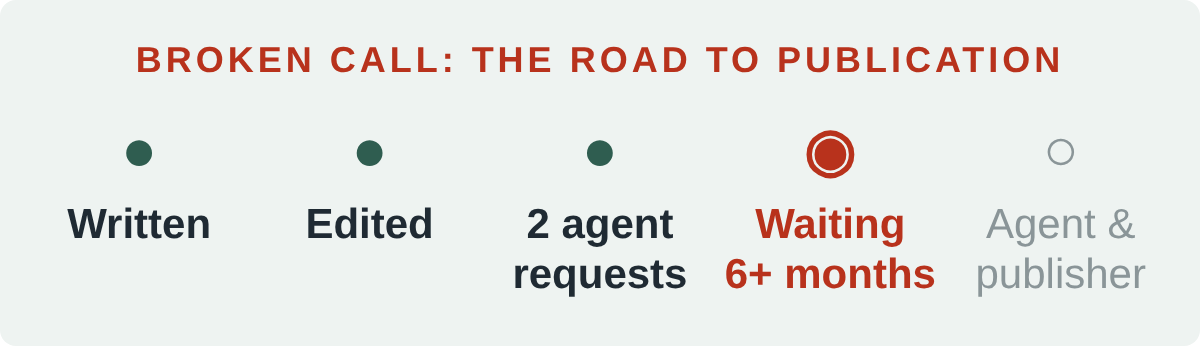
I am still on the road to publication! The book is completed and edited, with two full manuscript requests from agents. Now I wait at least 6 months until they get back to me. Publishing, it turns out, moves at the speed of a prior authorization. Thank you for following along.
As always, talk to your own doctor, not the internet (even me).
Dr. Jessica Faraci
P.S. Know someone still calling around for a family doctor, or who just likes a good story? Send them this page. They can sign up at drjessicafaraci.com/newsletter.
For general education, not medical advice. Please talk to your own doctor about your care. For book or speaking inquiries: drjessicafamilymedicine@gmail.com
Sources: Milbank Memorial Fund 2026 Scorecard (3 in 10; the nickel) · AAMC physician workforce projections, 2024 (20,000 to 40,000 by 2036) · AMA burnout survey, 2025 (45% of family doctors) · Porter et al., JGIM 2023 (26.7 hours; about 9 with a team) · Macinko, Starfield & Shi, 2007 (5% fewer deaths) · Basu et al., JAMA Intern Med 2019 (51 days) · Baicker & Chandra, Health Affairs 2004 (quality and spending) · OECD Health at a Glance 2025 (14 cents) · Starfield, Shi & Macinko, Milbank Quarterly 2005 (countries)